

Introduction
When I first came to Korea as an exchange student, it was my first time really “moving” abroad.
Before that, I had traveled before, but moving is different. Suddenly, you are not just thinking about what clothes to pack or which places to visit. You start wondering about documents, visas, insurance, phone numbers, accommodation, bank cards, and all the small things that can make the first weeks either smooth or stressful.
At that time, I honestly had no clue what I needed.
I did not know what to bring, where to look for reliable information, which documents mattered, or what I should prepare before getting on the plane. I was mostly figuring things out as I went.
Now, after going through different visa processes, living in Korea long term, setting up a company here, and helping many people understand Korean systems, I have a much clearer idea of what actually matters before arriving.
The good news is that the process is mostly straightforward once you understand the order.
The difficult part is that information is scattered everywhere. One person says one thing, a blog says another thing, your embassy website says something slightly different, and then someone in a Facebook group tells you something from five years ago.
So this guide is meant to give you a simple pre-arrival overview.
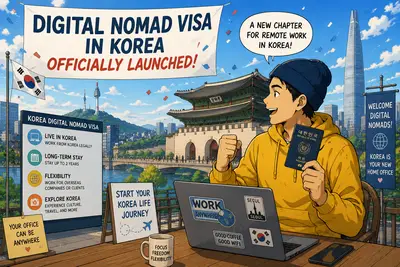
It is for people moving to Korea on a long-term visa, meaning a stay of more than 90 days. This can include visas like a Working Holiday Visa, Digital Nomad Visa, Student Visa, Professional Work Visa, or other long-term visa types.
The goal is not to explain every visa in detail. Each visa has its own rules.
The goal is to help you prepare before you arrive in Korea, so you are not sitting in your room one week before departure thinking:
“Wait, what am I actually supposed to bring?”
Understand Your Visa Before You Prepare Anything Else
Before you book flights, accommodation, or start packing your suitcase, the first thing you need to understand is your visa.
This sounds obvious, but many people start with the wrong question.
They ask:
“What documents do I need for Korea?”
But the better question is:
“What documents do I need for my specific visa, through the Korean embassy in the country where I am applying?”
That difference matters a lot.
Korea has many visa types, and each one has different requirements. A student visa will not have the same document checklist as a working holiday visa. A professional work visa will not be the same as a digital nomad visa. Even within similar visa categories, requirements can change depending on your nationality, your embassy, and your personal situation.
So before doing anything else, get clear on three things:
- Which visa you are applying for
- Which Korean embassy or consulate is responsible for your application
- Which exact document checklist that embassy provides
Do not rely only on random blog posts, old YouTube comments, or someone who applied years ago. Those can be helpful for understanding the general process, but your actual checklist should come from the Korean embassy or consulate where you are applying.
For example, if you live in Germany and apply through the Korean embassy in Germany, check the Korean embassy website for Germany. If you live in another country, check the embassy or consulate responsible for that country or region.
This is one of those steps where being careful in the beginning can save you a lot of stress later.
Prepare Your Visa Application for the Korean Embassy
Once you know which visa you are applying for, your next step is to prepare the visa application for the Korean embassy.
The exact process depends on the embassy. Some embassies require an appointment. Some may allow mail-in applications. Some have very specific formatting rules. Some want originals, copies, translations, apostilles, or extra documents depending on your situation.
This is why you should always check the embassy website directly.
Do not assume that every Korean embassy works the same way.
A good process looks like this:
- Find the Korean embassy or consulate responsible for your country or region.
- Go to the visa section of their official website.
- Find the page for your exact visa type.
- Download or copy the latest document checklist.
- Check whether you need an appointment or can apply by mail.
- Prepare documents exactly according to that embassy’s instructions.
- Make digital copies of everything before submitting.
- Keep track of what you submitted.
This may sound basic, but it is very easy to mix up information from different countries. Maybe you read a checklist from the Korean embassy in the US, but you are applying in Germany. Or you saw a post from someone applying in Australia, but your embassy asks for different proof.
Use other people’s experiences as reference.
Use your embassy checklist as the source.
General Documents You May Need
Every visa is different, but many long-term Korea visa applications ask for similar categories of documents.
This does not mean you will need every item on this list. It means these are common types of documents you should expect to prepare or at least check.
You may need:
- Passport
- Copies of your passport
- Visa application form
- Passport photos that match the embassy’s photo rules
- Proof of visa purpose
- Financial proof
- Health insurance documents
- Background check if required
- Apostille if required
- Medical check if required
- Proof of accommodation if requested
- Flight ticket or flight reservation if requested
- Return ticket or onward ticket if requested
- Additional supporting documents depending on your visa type
Your proof of purpose depends on the visa.
For example, this could be:
- Admission letter for a student visa
- Employment contract for a work visa
- Invitation letter
- Sponsorship documents
- Company documents
- Remote work proof
- Income documents
- Scholarship letter
- Program confirmation
Financial proof also depends on the visa. It could include bank statements, income proof, scholarship proof, or sponsor statements.
The tricky part is that these documents may need to be recent. Some embassies may only accept bank statements issued within a certain timeframe. Some documents may need official stamps, translations, or apostilles.
This is why you should not prepare everything too early without checking the rules. Some documents can expire before your appointment if you prepare them months in advance.
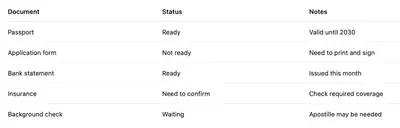
A good habit is to create a checklist with three columns:
- Required document
- Status
- Notes
Be Careful With Flight Tickets
Some embassies may ask for flight tickets or proof of planned travel.
This can be annoying because you may not want to book a flight before your visa is approved. At the same time, you may need to show some kind of travel plan.
If flight tickets are required, it can be safer to book a refundable or flexible ticket. That way, if your visa process takes longer than expected or something changes, you are not stuck with an expensive ticket you cannot use.
Do not book the cheapest non-refundable ticket just because it looks convenient in the moment.
Visa processing can take time. Embassies can ask for extra documents. Appointments can be delayed. Your plans may shift.
A flexible ticket can give you peace of mind.
Again, check what your embassy actually requires. Some may ask for a flight reservation, some may ask for confirmed tickets, and some may not ask for flights at all.
Create a Digital Korea Folder
One of the best things you can do before moving to Korea is create a digital Korea folder.
This sounds simple, but it can save you so much time later.
When you apply for a visa, you collect many documents. After you receive your visa and move to Korea, you may need some of those documents again for immigration, housing, phone setup, banking, insurance, visa extensions, or future applications.
Do not let everything disappear in random email attachments, downloads folders, and WhatsApp chats.
Create one clean folder and keep everything there.
You may need the same file again months later and not remember where it came from. If you already have everything organized, the next step becomes much easier.
Book Your First Accommodation Before Arrival
Before arriving in Korea, you should already have a place to stay.
It does not need to be your permanent home. In fact, for many people, it is better if it is not your permanent home yet.
When you first arrive, you may not know which neighborhood fits your lifestyle. You may think you want to live in one area, but after a few weeks, you realize another area feels much better. Seoul especially can feel very different depending on where you stay.
Hongdae, Mangwon, Yeonnam, Seongsu, Gangnam, Itaewon, Sinchon, Jamsil, and other neighborhoods all have their own atmosphere. Your commute, lifestyle, gym, cafés, friends, and budget can all affect where you want to live.
So for the first few weeks, it can be completely fine to stay in:
- Hotel
- Guesthouse
- Airbnb
- Serviced apartment
- Short-term rental
- Flexible stay
Before you register in Korea at immigration, you do not necessarily need to have your final long-term apartment already. You need somewhere to land first. A temporary place gives you time to explore, recover from the flight, and make better decisions.
The mistake is rushing into a long-term contract before understanding the city.
Korea’s rental system can be very different from what you are used to. Deposits can be high, contracts can be confusing, and not every place is foreigner-friendly. If your Korean is limited, it can also be difficult to judge whether a rental condition is reasonable.
So unless you already know exactly where you want to live, give yourself some breathing room.
Get a Temporary SIM Card or E-SIM
Having internet when you arrive in Korea is one of the most important things.
This might sound obvious, but it affects almost everything in the beginning.
You need internet for:
- Maps
- Translation apps
- Airport transportation
- Messaging your accommodation
- Booking confirmations
- Calling or messaging people
- Looking up addresses
- Checking immigration information
- Using KakaoTalk
- Finding food
- Emergency situations
Even if Korea has a lot of public Wi-Fi, I would not rely on Wi-Fi only when you first arrive.
A temporary SIM card or e-SIM makes your first days much easier. You can usually prepare this before arrival or pick it up at the airport. Some people prefer e-SIM because it can be activated quickly without changing a physical SIM card. Others prefer a physical SIM, especially if their phone does not support e-SIM.
Before buying one, check:
- Does your phone support e-SIM?
- Is your phone unlocked?
- Does the plan include a Korean phone number?
- Is it data-only or does it include calls and SMS?
- How long is the plan valid?
- Can it be extended?
- Can it later be connected to your Residence Card, or is it only temporary?
For the first days, even a data-only option can be helpful. But for long-term life in Korea, having a Korean phone number becomes very important later, especially for verification.
At the pre-arrival stage, your goal is simple:
Make sure you can use the internet immediately after landing.
Do not arrive in Korea with no data, no translation app, no map, and no way to contact your accommodation.
That is just unnecessary stress.
Prepare Your Payment Options
Before moving to Korea, check your debit and credit cards.
In Korea, card payments are widely accepted, but foreign cards do not always work everywhere. Some online services may reject foreign cards, and some local systems are easier once you have a Korean bank account.
But you will not have a Korean bank account immediately when you arrive.
So for the first weeks, prepare backup payment options.
Bring:
- One main debit or credit card (Personal Recommendation Wise or Revolut)
- One backup card
- A small amount of Korean won
- Possibly some EUR or USD depending on your situation
Visa and Mastercard are usually the safest options. Make sure international payments are enabled before you leave. Also tell your bank you are traveling or moving abroad if your bank tends to block foreign transactions.
Do not rely on only one card.
Cards can get blocked. ATMs can reject them. Your bank app may require SMS verification from your home number. Sometimes things just do not work when you need them most.
A backup card can save you.
I would also prepare some Korean cash before or shortly after arrival. You do not need a huge amount because Korea is very card-friendly, but having emergency cash is helpful for transportation cards, small vendors, or situations where your foreign card does not work.
What To Pack: Bring Less Than You Think
Moving abroad makes you want to pack your entire life. For Korea, pack lighter. Most basics are easy (and often cheaper) to buy once you land, and hauling 30 kg up a random hill with no elevator is a special kind of pain.
My rule: don’t bring your home. Bring the essentials, then buy the rest here.
Essentials To Bring
- Passport + copies (1 printed, 1 digital)
- Visa documents (grant notice/confirmation; printed + saved on your phone)
- 2 payment cards (Visa/Mastercard; enable international use; check fees)
- Insurance info (PDF + key numbers accessible offline)
- Some cash (small KRW amount; optional EUR/USD as backup)
- Prescription medication (enough for the first period + prescription copy; check legality)
- Key electronics (phone, laptop, chargers; confirm access to accounts)
- Universal adapter (Korea uses 220V Type C/F)
Helpful First-Week Items
- Small toiletries kit
- Deodorant (if you’re brand-specific)
- Basic meds you trust
- Power bank + pen
- Document folder
- Reusable shopping bag
Buy in Korea Instead
Shampoo/body wash, detergent, hangers, towels, kitchen basics, umbrella, slippers, storage boxes, stationery, bedding, small appliances, extra clothes. Start at Daiso for cheap basics; use Karrot Market (당근마켓) for secondhand.
Clothing Tip
Pack for one week, wash, then adjust. Pack for your arrival season (Korean summers and winters are intense). If sizing is hard for you in Korea, bring more from home.
Shipping
Unless you’re settling long-term or moving with family, don’t ship your whole life. You’ll likely change addresses, underestimate storage, and overpay to move things you won’t use.
Conclusion
Preparing to move to Korea on a long-term visa can feel overwhelming at first because there are many small things to think about.
But once you organize the process, it becomes much more manageable. The most important thing is to prepare in the right order. First, understand your visa and embassy requirements. Then organize your documents. Book your first accommodation. Prepare your phone and payment options. Pack only what you really need.
You do not need to bring your whole life to Korea.
Korea has almost everything you need, and many things can be bought after arrival. What matters more is arriving with the right documents, a place to stay, internet access, payment options, and enough flexibility to figure things out step by step.
When I first moved abroad, I did not know any of this clearly. I was just trying to make sense of everything as it happened.
Now I would do it very differently.
I would prepare my documents properly, pack much lighter, book a flexible first stay, make sure I have internet from day one, and give myself time to settle before making big decisions.
Moving to Korea does not have to be perfect from the beginning.
You just need a good foundation.
The rest will become clearer once you arrive.
🏠 Looking for Housing in Korea? Renting Made Easy!
10% Off Service Fee with code:
KIMNINJA10
Enkostay Benefits:
✅ No Deposit ✅ Online Booking ✅ Immigration-friendly docs ✅ Flexible Contracts
Perfect for:
👨🏻💻 Digital Nomads 🎓 Students ✈️ Long-Term Travelers 🧳 Working Holiday
📬 Weekly Tips in Your Inbox
Whether you’re visiting, staying long-term, or relocating. I share honest insights, guides, and tools to help you navigate life in Korea.
Join 1,000+ readers learning how to live smarter in Korea, from visas to vibes.
👋 About Kim Ninja

Kim Ninja (Nguyen Huy Kim)
🧭 Cultural Guide · ✍️ Storyteller · 🎨 Curator
📢 Creator helping foreigners understand and thrive in Korea
🗺️ I turn everyday challenges into comics, guides, and stories
The blog published by Kim Ninja (Huy-Kim Nguyen) is available for informational purposes only and is not considered legal advice on any subject matter.