

Introduction
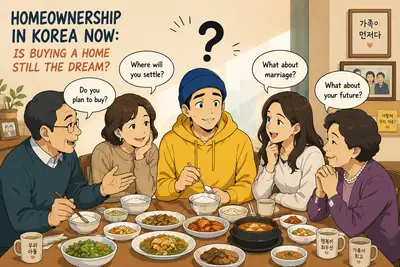
Now that I am in my mid-thirties, one question comes up more often than before: do I plan to buy a home one day?
It usually comes up when people talk about marriage, family, or settling down. In many cultures, owning a home is still seen as the natural next step once you reach a certain age. You study, work, save money, get married, buy a home, raise a family, and slowly build a stable life. It is the script many of us grew up around, even if our actual lives look very different now.
In Korea, this question feels even heavier because housing is not just about having a place to live. It is tied to status, marriage, family expectations, financial security, and the idea of whether someone is “ready” for adult life. For a long time, real estate in Korea was also one of the clearest investment paths. If you bought the right apartment in the right area, especially in Seoul, it could become the biggest financial win of your life.
But in this day and age, I wonder if that old idea still makes sense for everyone.
Housing prices are high, household debt is heavy, jeonse is changing, monthly rent is becoming more common, and younger people are questioning whether they can or even want to follow the same path as their parents. I do not fully understand every part of the Korean housing market, and I do not want to pretend that I do. But as someone who lives in Korea, comes from Germany where renting is normal, and values flexibility, I find myself thinking about this topic more and more.
This article is not financial advice. It is more of a reflection on Korea’s homeownership culture, the pressure behind it, and why I personally do not see owning a home as the only correct path.
👉The Complete Housing Guide for Foreigners in Korea
👉Housing Types in Korea: Officetel, Apartment, Villa, House, and More
👉🇰🇷 🏡 Renting in Korea Just Got Easier! Find Housing with Enkostay!
👉Why Koreans Don’t Invite You To Their Homes
My Own Relationship With Homeownership
My view on homeownership is shaped a lot by my family. My mom always dreamed of owning a home, partly because people around her did. Some of my uncles owned homes, and for her generation, that represented stability and success. It was something solid, something you could point to and say, “We built this.”
My dad saw it differently. He never really moved from his position that renting made more sense for our family. With his salary level, buying would not have been a simple upgrade. It would have meant taking on debt, moving farther away from the city center, and creating a financial burden that would probably have affected the whole family. Even if the debt was technically my parents’ responsibility, family debt rarely stays purely financial. It changes the mood at home, the options children feel they have, and the risks the next generation can take.
Looking back, I think his decision gave me a lot of freedom. I graduated debt-free, had more flexibility, and was able to save and invest without feeling like I had to help carry a family housing burden. My parents have lived in the same flat for more than 30 years, and because the contract is old and still affordable, it remains manageable even on my father’s pension.
What is interesting is that my mom’s view also changed over time. After seeing some of her retired friends deal with the reality of homeownership, she started to notice the other side of the dream. Owning a home can bring security, but it also brings maintenance costs, utility costs, repairs, taxes, and the responsibility of taking care of something that slowly ages with you. A home can be an asset, but it is never free, even after the loan is paid off.
That experience shaped how I think today. I understand why people want to own a home, but I do not automatically see renting as failure.
Why Korea Feels Different
Coming from Germany, renting never felt strange to me. Many people rent for years, sometimes for their whole lives. It does not automatically mean they failed, and it does not mean they are irresponsible. You can rent, live well, save money, invest, and still build a stable life.
In Korea, the feeling is different. Monthly rent, or weolse, often carries a weaker image compared to jeonse or ownership. Owning is still seen as the strongest position. Jeonse sits somewhere in the middle, because even though you do not own the home, you put down a large deposit and avoid or reduce monthly rent. Weolse, on the other hand, can feel like money disappearing every month.
I understand why people think that way. Korea’s housing history is very different from Germany’s. For a long time, real estate was not just housing. It was one of the main ways families built wealth. Apartments became investment vehicles, and the belief that good property would rise in value became deeply embedded in society.
That belief shaped how people talked about housing, marriage, family planning, and social status. Buying a home was not only about having a place to live. It was about securing your future and proving that you had made it.
But the problem with any old success formula is that it may not work the same way for the next generation. If your parents bought when prices were lower, salaries were different, and debt felt more manageable, their experience may not translate directly to young people trying to buy today.
Housing and Marriage in Korea
One of the most important cultural layers in Korea is the connection between housing and marriage. Traditionally, there has been strong pressure on men to provide housing when getting married. Ideally, that meant buying a home. If buying was not possible, then at least preparing a jeonse place was often seen as the compromise.
This expectation may be changing, especially among younger couples who share costs more equally, but old ideas do not disappear overnight. They stay in family conversations, wedding expectations, and the quiet pressure people feel when they compare themselves to others.
For men, this can create a heavy burden. If someone feels he cannot even prepare jeonse, marriage may already feel out of reach before the relationship begins. For women, the pressure can also appear in a different way, through family expectations about what kind of partner is “stable” enough. Marriage then becomes less about two people starting a life together and more about whether the financial foundation looks respectable enough from the outside.
This is one reason Korea’s housing problem is not only an economic issue. It affects relationships, marriage timing, family planning, and the emotional idea of adulthood. If people feel they need to solve housing before they can even begin married life, then marriage becomes a much bigger project than love and commitment.
In many other countries, couples might start small, rent together, slowly save, and maybe buy later. In Korea, that path exists too, but it can still feel like a compromise compared to the old ideal of starting married life with jeonse or ownership already secured.
The Changing Role of Jeonse
Jeonse is one of the most unique parts of Korean housing. For many foreigners, it is hard to understand at first because the deposit amounts can be shocking. Instead of paying normal monthly rent, you put down a large lump sum and live in the home with little or no monthly payment. In theory, you receive the deposit back at the end of the contract.
For a long time, jeonse played an important role in Korea’s housing ladder. It was not ownership, but it gave people a sense of stability. It allowed households to live without monthly rent pressure, and for many couples, it was the realistic middle step before buying.
But jeonse has also become more difficult. Deposits are high, risks became more visible after jeonse fraud cases, and the market has been shifting more toward monthly rent. For young people, this creates a difficult choice. Buying is expensive, jeonse requires a huge deposit, and weolse is still often viewed as less desirable even though it may be the only realistic option.
This is where I think the cultural mindset has not fully caught up with reality. If monthly rent becomes more common because the market changes, then society also needs to stop looking down on it so much. Otherwise, people are pushed into feeling ashamed of the only option they can realistically afford.
Monthly Rent Is Not Always Wasted Money
One idea I hear often in Korea is that paying monthly rent is wasted money. I understand the logic. If you pay rent, the money is gone. You do not build ownership. You do not gain an asset. You are paying someone else.
But I think this comparison is too simple.
When you own a home, money also disappears in other ways. Interest payments disappear. Maintenance costs disappear. Property taxes disappear. Repair costs disappear. Opportunity cost disappears. The money locked into the home cannot easily be used for other investments, business opportunities, travel, or simply staying flexible.
Rent is easy to see because it leaves your account every month. Ownership costs are often less visible because they are spread across different categories and hidden behind the idea that the home is an asset.
That does not mean renting is always better. It just means renting is not automatically stupid. Sometimes rent buys flexibility. Sometimes it buys location. Sometimes it allows you to live close to work, friends, and community without taking on massive debt. Sometimes it lets you keep your savings invested elsewhere.
For my own lifestyle, this matters a lot. I travel, I work online, I spend time between different places, and I do not know exactly where I will be in ten years. When I go abroad for a while, friends sometimes ask me what I do with my place when it is empty. My answer is simple: nothing. I just leave it there.
Because I rent, that does not feel like a huge emotional burden. I do not need to worry about owning an empty home, renting it out, maintaining it, or tying too much of my life to one property. For someone else, that might feel unstable. For me, it fits the way I live.
Debt Changes the Meaning of Ownership
The emotional image of homeownership is simple: you own your place, and therefore you are secure. But for most people today, buying a home does not really mean owning it outright. It means taking on a large loan and slowly paying it back over many years.
In Korea, this matters a lot because household debt is already a major issue. The Bank of Korea reported household credit at 1,968.3 trillion won at the end of the third quarter of 2025, which shows how deeply debt is connected to everyday financial life. Mortgage rules have also become stricter, including caps on housing loans in the Seoul metropolitan area and regulated regions.
These rules exist because the government also knows that housing debt can become dangerous. When too many people borrow too much to buy assets they believe will keep rising, the whole system becomes more fragile.
For Koreans, getting a mortgage is already shaped by income, debt ratios, property location, and government policy. For foreigners, it can be even harder. Even if foreigners can buy property in Korea, getting a housing loan is not always simple. Banks may look at visa status, Korean income, employment stability, credit history, residency record, and whether the person fits neatly into the local financial system.
This is something I think many foreigners underestimate. Buying property is not only about whether you have enough money. It is also about whether the Korean banking system sees you as someone it wants to lend to.
The Foreigner Perspective
As a foreigner in Korea, I already know how many systems become easier only after you are properly inside them. Phone verification, banking, credit cards, housing contracts, and loans all work much more smoothly when you fit the expected profile.
But many foreigners do not fit that profile perfectly.
Some earn money from abroad. Some are self-employed. Some run companies. Some are on visas that need to be renewed. Some have savings but not a long Korean credit history. Some have income that makes sense globally but looks unusual to a local bank.
This does not mean buying is impossible. But it does mean the process may be harder than people expect. And before making a decision as big as buying property, I think foreigners especially need to be honest about their long-term plans.
Do you really want to live in Korea for the next ten or twenty years? Is your visa stable? Is your income stable in a way Korean banks understand? Would you still want the home if the price did not rise for a long time? What happens if you need to leave Korea?
These are not questions that make homeownership bad. They simply make it more complicated.
Young People and the Search for Another Path
One reason the housing question feels different today is that young people are looking for other ways to build wealth. Many are interested in stocks, crypto, side hustles, online income, and overseas investing. In some ways, this makes sense. If real estate feels impossible, people start searching for alternatives.
But I also notice that many people do not really think in terms of long-term investing. They think more in terms of trading. They go in and out of positions, gain a little, lose a little, and treat the market almost like a casino.
This is not only a Korean thing. It happens everywhere now because trading apps made everything easy and fast. But in Korea, it is interesting because the old real estate dream was also built on a kind of belief that prices would keep rising. The asset may have changed, but the speculative mindset can stay the same.
For me, the better question is not simply whether real estate or stocks are better. The better question is what kind of life you are trying to build, and which financial structure supports that life.
If someone wants to settle in one place, raise children, stay close to family, and build a stable home, buying can make a lot of sense. If someone values mobility, business flexibility, travel, and being debt-free, renting and investing elsewhere may make more sense.
The problem is not buying or renting. The problem is treating one path as the only respectable path.
Is Korean Real Estate Still a Safe Dream?
I do not feel qualified to say whether Korea has a housing bubble that will burst. That is too big of a claim, and many people who understand the market better than me still disagree with each other.
What I can say is that Korea’s housing market feels like it is under tension.
On one side, demand in Seoul and the surrounding areas is still strong. Jobs, universities, hospitals, transportation, social life, and opportunity are heavily concentrated in the capital region. People do not just want any home. They want the right apartment in the right area, connected to the right schools, subway lines, and future value.
On the other side, affordability is a serious issue. Housing prices are high compared to normal salaries, household debt is already large, marriage and birth rates are low, and younger generations are questioning whether the old path is realistic. The jeonse system is also changing, and monthly rent is becoming more common, even if the culture still has not fully accepted it emotionally.
So maybe the answer is not that the dream is gone. Maybe the dream is becoming more selective. Buying in the right place with the right income and the right timing may still work very well. But buying just because everyone says you must buy may be much more dangerous now than it was for previous generations.
My Own Position
Personally, I still prefer to stay flexible, debt-free, and able to move. That does not mean I will never buy property, and it does not mean I think owning a home is wrong. I just know that my current lifestyle works better when I am not tied too heavily to one place and one large loan.
But I do understand my own lifestyle.
I also know that I do not understand everything about Korean real estate. There are tax rules, loan rules, ownership rules, market cycles, and cultural layers that I am still learning. So I do not want to act like I have the perfect answer.
I value freedom. I value flexibility. I value having savings that are not locked into one asset. I value being able to leave Korea for a while without worrying too much about an empty home. I value not carrying a huge amount of debt just to fit into someone else’s idea of adulthood.
That is why renting still makes sense for me right now.
For someone else, the answer may be completely different. If they have a stable job in Korea, a long-term family plan, local financing, and a clear desire to stay in one area, buying could be the right decision. I do not think this topic has one universal answer.
But I do think it deserves more honest discussion.
Conclusion
Homeownership in Korea in this age is no longer just a simple dream of stability. It is connected to debt, marriage pressure, social status, investment culture, changing rental systems, and the question of what kind of life people actually want to live.
For previous generations, buying property often made sense. It was a path to wealth, security, and respect. But for many people today, especially younger Koreans and foreigners living in Korea, the calculation is more complicated. Housing is expensive, loans are harder, jeonse is less simple than before, and the old idea that every responsible adult must eventually own a home does not fit everyone’s life anymore.
I understand why people still want to buy. There is emotional comfort in having your own place, and for some people that stability is worth the cost. But I also think renting deserves more respect, especially when it allows someone to live with less debt, more flexibility, and more control over their own choices.
Maybe the real question is not whether buying is always better than renting.
Maybe the better question is whether the home supports the life you actually want.
For some people, that life needs ownership.
For others, it needs freedom.
And for now, I know which one fits me better.
🏠 Looking for Housing in Korea? Renting Made Easy!
10% Off Service Fee with code:
KIMNINJA10
Enkostay Benefits:
✅ No Deposit ✅ Online Booking ✅ Immigration-friendly docs ✅ Flexible Contracts
Perfect for:
👨🏻💻 Digital Nomads 🎓 Students ✈️ Long-Term Travelers 🧳 Working Holiday
📬 Weekly Tips in Your Inbox
Whether you’re visiting, staying long-term, or relocating. I share honest insights, guides, and tools to help you navigate life in Korea.
Join 1,000+ readers learning how to live smarter in Korea, from visas to vibes.
👋 About Kim Ninja
Kim Ninja (Nguyen Huy Kim)
🧭 Cultural Guide · ✍️ Storyteller · 🎨 Curator
📢 Creator helping foreigners understand and thrive in Korea
🗺️ I turn everyday challenges into comics, guides, and stories
The blog published by Kim Ninja (Huy-Kim Nguyen) is available for informational purposes only and is not considered legal advice on any subject matter.